
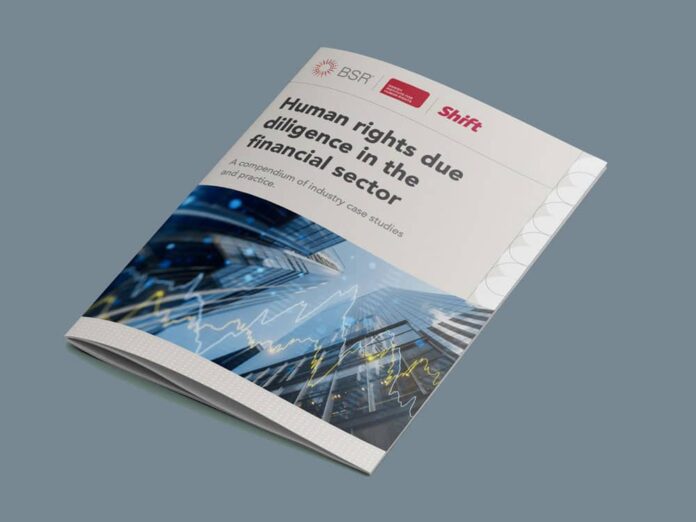
Stockholm (NordSIP) – As sustainable investors struggle to deal with the rise in global geopolitical instability, human rights are becoming an increasingly relevant factor for investment decisions. To address these concerns, a recent report co-authored by the Danish Institute for Human Rights, discusses several examples and approaches that financial institutions can follow to integrate robust human rights due diligence (HRDD) into their operations.
The publication, titled “Human Rights Due Diligence in the Financial Sector: A Compendium of Industry Case Studies and Practice,” argues that HRDD is transitioning from a niche concern to a fundamental responsibility, driven by international frameworks like the UN Guiding Principles and OECD Guidelines, alongside recent regulatory pressures, particularly within the EU. The point is illustrated with case studies, including the experience of thre nordic institutions.
A Cooperative Effort
The report was a joint effort from the Danish Institute for Human Rights, Business for Social Responsibility (BSR) and Shift. The analysis received considerable input from Nordic investors, including Sweden’s AP6, Denmark’s AP Pension and SpareBank 1 Sør-Norge, whose case studies are featured prominently.
The Danish Institute for Human Rights is Denmark’s national human rights institution, working to promote and protect rights both at home and abroad. BSR is a California-based business network and consultancy providing over 300 member companies with insight, advice, and collaborative initiatives create long-term value and scale impact. Shift is a New York City-based non-profit specialising on the UN Guiding Principles on Business and Human Rights, working to challenge assumptions, and redefine corporate practice.
Value Chain Challenges and Influence Opportunities
The report highlights the unique challenges faced by financial institutions, whose investments often have complex and extensive value chains. Assessing and addressing human rights impacts requires moving beyond traditional ESG risk management to an “impact materiality” lens, prioritising severe impacts on people regardless of immediate financial consequence.
The report argues that the key to maturing HRDD involves developing sound policies, systematic processes, and effective prioritisation strategies, especially given data limitations. Financial institutions are urged to deploy their commercial, relationship-based, expertise-driven, collaborative, and “podium power” to influence clients and investees towards better human rights outcomes.
Case studies – AP6, SpareBank and AP Pension
Case studies within the report showcase diverse approaches and highlight the leadership of Nordic investors. AP Pension refined its HRDD governance in response to EU sustainability regulations, improving data quality and internal monitoring. SpareBank 1 Sør-Norge in Norway is integrating human rights into corporate lending, using ESG assessments and engaging in collective initiatives like the Responsible Ship Recycling Standard.
Sweden’s AP6, a state-owned pension fund focusing on private equity, has developed an 11-question assessment tool for General Partners and actively supports them in strengthening human rights practices.
Danish pension fund AP Pension has re-evaluated its HRDD framework in response to the EU’s Sustainable Financial Disclosure Regulation (SFDR). This prompted improvements in data quality, the establishment of an internal database for monitoring and setting engagement thresholds, and the assignment of sustainability data management
Nordic financial institutions such as Folksam, PFA Pension, PensionDanmark, Storebrand, DNB, Nordea, AP Funds, and ATP Livslang Pension are also cited for their collaborative engagement. Examples of this cooperative approach include dealing with Tesla’s labor practices, human rights concerns in the Uyghur region and divestment from companies like Grupo Mexico over environmental and human rights impacts.
These actions highlight a regional commitment to leveraging financial influence for global human rights improvements.
